QuotientQuotientQuotient
Skip to main content
Quotient SignalsQuotient SignalsQuotient

The markets where Q sees an edge.

Q prices every market and finds many mispriced. Signals are the rare ones with an edge and a near-term reason the market may reach Q’s price.

Illustration of Q pricing a field of markets and elevating one rare Signal. The featured card shows a real published Signal: GPT-5.6 released by June 15, 2026? The market priced NO at 29 cents against Q's fair price of 41 cents, 12 cents of upside.

This is a Signal.

A forecast tells you what Q expects. A Signal adds three things: an edge, a near-term reason the market may reach Q’s price, and a defined exit. The exit is Q’s price, or day seven.

POLYMARKETNOSIGNAL PUBLISHED · JUNE 2

GPT-5.6 released by June 15, 2026?

Q fair price · NO41¢
Market price · NO29¢
Upside+12¢

Hold 7 days

+154% paper return

Based on the market price on June 9, seven days after publication.

Positions can be held past the window to resolution. The track record does not measure those outcomes.

Prices shown for the NO contract
  • Market price
  • Q fair price
  • Upside
  • Q updates
  1. Signal published · NO at 29¢
  2. Upside persisted
  3. Market reached Q’s price
  4. Market later resolved NO · June 15
WHAT Q SAW
  • The contract counted only a model released under the exact name GPT-5.6 by June 15.
  • Q separated broad release expectations from that exact naming test.
  • That reading put Q's fair price for NO at 41¢ while the market offered NO at 29¢.
  • The fixed thirteen-day window gave the market a near-term path to Q's price.

Every signal. Every outcome.

The Track Record measures every Signal from its published reference price to its price on day seven, using the resolution price when the market settles sooner. Each Signal's take-profit is a separate exit reference that may be reached earlier.

Average paper return per SignalAcross published Signals with measurable paper results. Open paper positions are marked to the current market price.
Win rateShown once a position closes.
Published SignalsLive from the published record.
Selected closed paper resultsAwaiting live data
ContractSideEntryExitReturnStatus
Paper performance · Hold 7 days

These results are based on simulated or hypothetical performance results that have certain inherent limitations. Unlike the results shown in an actual performance record, these results do not represent actual trading. Also, because these trades have not actually been executed, these results may have under- or over-compensated for the impact, if any, of certain market factors, such as lack of liquidity. Simulated or hypothetical trading programs in general are also subject to the fact that they are designed with the benefit of hindsight. No representation is being made that any account will or is likely to achieve profits or losses similar to these being shown.

What goes into a Q forecast.

Q combines broad evidence with scored expert judgment to form an independent view of each market.

6,000+global sources

Quotient reviews primary records, structured data, polling, and independent reporting.

1,000+ranked experts across geopolitics, tech, macroeconomics, and AI

Q tracks expert forecasts and scores every call against outcomes to identify who adds signal before the outcome is known.

RESEARCH DRAWS ON
ReutersRANDBloombergIPSOSAFPThe New York TimesCENTCOMPoliticoThe GuardianFinancial Times

How Q keeps improving.

Quotient’s Research Lab studies forecast outcomes to improve how Q weighs evidence, evaluates experts, and identifies Signals.

WHAT QUOTIENT’S RESEARCH LAB TESTS

  1. Call accuracy

    Calibration, expert records, and the evidence that improves Q's calls.

  2. Signal outcomes

    Entry timing, catalysts, exit windows, and the rules that improve Signal results.

  3. Forecasting beyond markets

    The same forecasting discipline applied to geopolitical, policy, and business questions beyond traded markets.

Recent report from Quotient's Research Lab
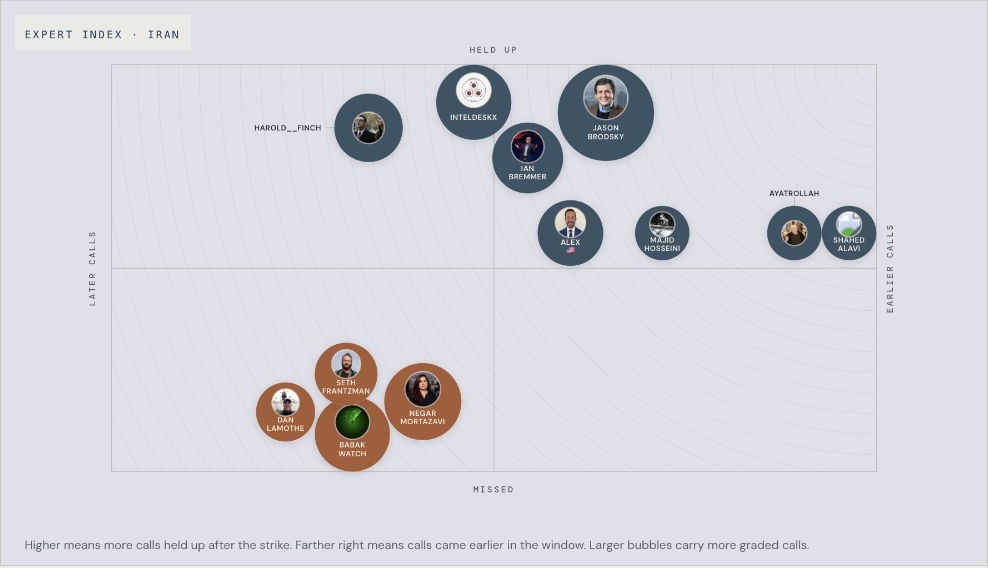
Expert Index chart plotting Iran predictions by whether they held up and how early each call appeared

Whose Iran calls held up?

The Iran Expert Index scored forecasts against outcomes to identify who added signal before the outcome was known and what Q should weight in future forecasts.

541 predictions126 experts
Read the report

What members receive.

Membership opens the full forecasting layer with every qualifying Signal, Q's broader forecasts across markets, and the complete record behind each call.

Every qualifying Signal

Receive every Signal when Q publishes one. A market must show both an edge and a near-term reason it may reach Q’s price.

All Q forecasts

See Q's broader forecast coverage across markets, including forecasts that never become Signals.

Complete Signal context

See the direction, reference entry, Q fair price, market price, upside, thesis, target, and market link.

The complete track record

Review every open and closed paper position and follow each Signal from publication through its recorded outcome.

Access for $QUOTIENT holders.

Launch access

Hold 10,000,000 $QUOTIENT

Holders of 10,000,000+ $QUOTIENT get exclusive access to the app.

Get $QUOTIENT

Signing is free and proves you own the wallet. It cannot move funds.

Know what you are buying.

When and where are new Signals published?

Any new Signals for the day are published by 11:00 a.m. ET. Log in to your Quotient Signals account to view them in the member dashboard. If no market clears Quotient's Signal standard, no new Signal is published that day.

Is Quotient Signals a trading platform?

Quotient Signals publishes prediction-market research. It does not operate a trading venue, accept customer trading funds, place trades, or custody assets. Members decide whether and how to act on the research and transact directly with third-party venues, subject to each venue's rules.

What does the track record include?

The aggregate track record covers published Signals with measurable paper results under Hold 7 days. The win rate uses closed paper positions only. Open paper positions are marked to the current market price. The public ledger shows the highest ChatGPT-market paper return and the two highest non-ChatGPT closed paper returns. Members can inspect the complete row-level record. View the track record

How are paper results calculated?

Each Signal receives an equal $100 paper stake at its published reference entry. The paper position closes after seven days or when the market resolves, if earlier. Return is the percentage change in the cost of the signaled side from entry to close. Until then, the position is marked to the current market price. Read the methodology

Why might my result differ from the paper result?

Paper results do not represent actual customer trades. They exclude fees, bid-ask spread, slippage, taxes, and other execution constraints. Liquidity, position limits, venue access, fill availability, timing, and the price available when a person acts can also affect an actual outcome.

How does access work?

During launch, access requires holding the displayed amount of $QUOTIENT in a self-custodied wallet. Connect your wallet and sign a free message to verify. Signing is not a transaction and cannot move funds. Access continues while the wallet holds the required balance.

Can I access every linked market from my location?

Quotient Signals membership provides research access. Whether you can use a linked trading venue depends on your location, eligibility, and that venue's rules. Quotient does not operate those venues or determine eligibility.

One token, every signal.

Get access